North Malé vs South Malé Atoll: Reefs, Surf, Diving and Local Islands Compared

In this article
Updated October 2026
North Malé and South Malé are the two atolls closest to Velana International Airport, and resorts in both are reached by boat in about ten minutes to an hour. The real difference is the water. North Malé has more of the reefs you can swim to from the beach, a string of well-known surf breaks and several resorts with a seaplane, while South Malé has the strong channel drift dives and Maafushi, a local island where guest houses have run since 2010.
Where the two atolls are
An atoll is a ring of coral reef with islands scattered around it. North Malé Atoll holds the capital, Malé, and the airport island of Hulhulé. South Malé Atoll lies to the south, across Vaadhoo Kandu. A kandu is a channel through the atoll rim, where the tide pushes water in and out, and Vaadhoo Kandu is the one that separates the two atolls. Apart from the city of Malé and its neighbouring islands, the airport among them, both fall within Kaafu, the administrative atoll whose capital is Thulusdhoo, a local island in North Malé.
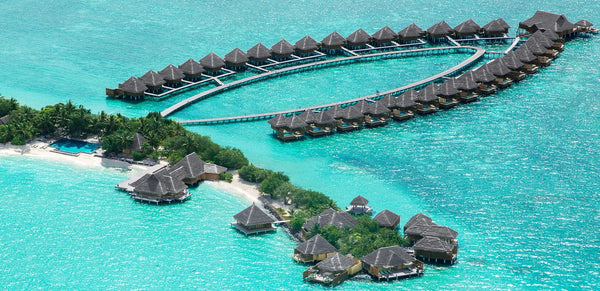
The distances are small on either side. In North Malé, Bandos Maldives is about ten minutes from the airport by boat and Kagi Maldives Resort & Spa, at the atoll's northern tip, about an hour. In South Malé, Taj Exotica Resort & Spa, Maldives, SO/ Maldives and Hard Rock Hotel Maldives are about 15 minutes away, and Waldorf Astoria Maldives Ithaafushi, Sun Siyam Olhuveli and OZEN Life Maadhoo about 45. Neither atoll is the remote option. For each island's boat time and late-night arrangements, see North Malé's boat-transfer islands, compared resort by resort.
Both atolls are close to the city, and both show it. From several North Malé islands, Malé's skyline and the aircraft are in view. In South Malé, guests at COMO Cocoa Island and OZEN Reserve Bolifushi can see building work on nearby islands, and Hard Rock Hotel Maldives sits on man-made islands with a marina.
Boats, seaplanes and late flights
Seaplanes in the Maldives fly in daylight only, so on a seaplane island a flight that lands in the evening means a night near the airport. In both Malé atolls the usual transfer is a boat that belongs to the resort and carries only its guests, which is what makes both atolls work for a late landing.
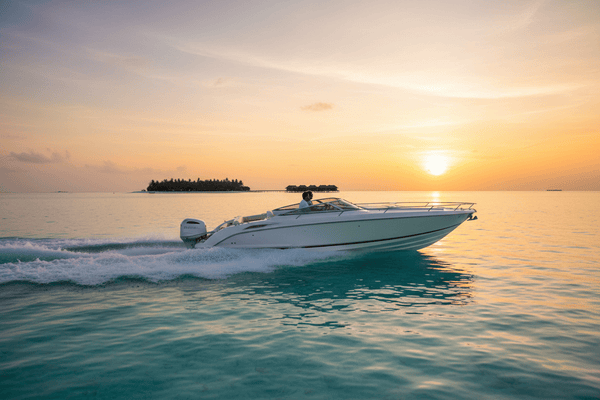
Not every one of those boats runs around the clock, though, and not every resort is boat-only. Kagi Maldives Resort & Spa's boat runs until 02:00 rather than around the clock, so a landing after that means a night near the airport. At Sun Siyam Olhuveli, night crossings depend on the weather. Some boats are timed to groups of flights: at OBLU NATURE Helengeli by SENTIDO, about 50 minutes out on the outer edge of North Malé, the wait at the airport can run to two hours. The vessel varies too. OZEN Reserve Bolifushi sends a catamaran, about 35 minutes, and Waldorf Astoria Maldives Ithaafushi a yacht.
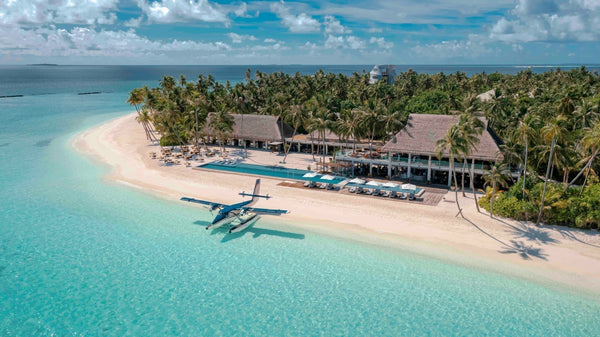
North Malé also has seaplanes. One&Only Reethi Rah is about 45 minutes by its own boat or about 15 by seaplane. Patina Maldives, Fari Islands is 45 minutes by boat or 10 to 15 by seaplane, while The Ritz-Carlton Maldives, Fari Islands, next door on the same built group of islands, is reached by boat alone, also in about 45 minutes. Jumeirah Olhahali Island is about 55 minutes by boat or 15 by seaplane, and Kagi Maldives Resort & Spa about 20 minutes in all by seaplane and a short boat. All of those flights are daylight only, so after dark the boat is the way in.
The water in North Malé: reefs to swim to and manta season
A lagoon is the shallow, sheltered water between an island and its outer reef. A house reef is the coral reef you can swim to from the resort itself, and this is where North Malé pulls ahead.
Several North Malé islands have a reef worth planning a holiday around. At Kagi Maldives Resort & Spa, two or three minutes over the lagoon bring snorkellers to big coral outcrops running down to a drop-off, with turtles most days, although only part of the reef is open to snorkellers. OBLU NATURE Helengeli by SENTIDO has blacktip and grey reef sharks, hawksbill turtles and eagle rays, with lifeguards stationed along the snorkelling route. At Bandos Maldives a snorkeller can swim right around the island, with several places to get in and a current to plan around. The built islands are the exception: the Fari Islands have no natural reef ringing them.
The dive sites are a short boat ride away. A thila is a reef top that rises from the atoll floor without breaking the surface. Banana Reef, HP Reef and Lions Head are protected marine areas. The Lions Head wall and the wreck of the Maldive Victory, off the airport island, are dives for experienced divers.
Manta Point at Lankan is a cleaning station, a spot on the reef where mantas wait while small fish clean them. Mantas come mostly in the wetter south-west monsoon, roughly May to November, when plankton fills the water. The drier north-east monsoon, roughly December to April, brings calmer seas and clearer water at the channel entrances.
The water in South Malé: channels and drift dives
South Malé's character comes from its channels. Six of them let strong currents into the atoll. A drift dive is one where divers let that current carry them along the reef rather than swimming against it, and the sites South Malé is known for are drift dives.
Embudhoo Kandu and Guraidhoo Kandu have both been protected marine areas since 1995. Embudhoo Kandu is a long drift with whitetip and grey reef sharks. Guraidhoo Corner is a classic drift where grey reef sharks and eagle rays gather when the current runs in, and the channel is recognised as an Important Shark and Ray Area. Kandooma Thila, a pinnacle with its top at about 12 metres, is not a site for beginners. For newer divers, the shallow wreck of the Kuda Giri can be dived without fighting the current. Channel diving is at its peak in the drier north-east monsoon.
Hard coral cover is better in North Malé, and the reefs off South Malé's resort islands are more modest. The strongest reefs to swim to are at COMO Cocoa Island, where every villa has steps into the lagoon and three reef areas suit different levels of confidence, at OZEN Reserve Bolifushi, with easy entry in front of the spa, at Sun Siyam Olhuveli, around the dive centre jetty, and at Waldorf Astoria Maldives Ithaafushi, straight off the Reef and Overwater Villas.
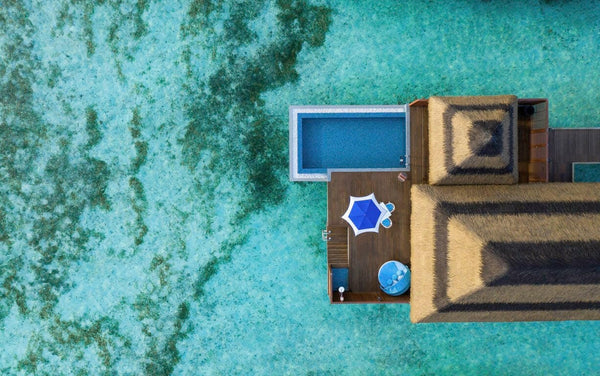
Several South Malé islands are lagoon or built-lagoon islands. Taj Exotica Resort & Spa, Maldives is a lagoon resort, with shallow, calm water a long way out and fish and rays around the water villa jetty. SO/ Maldives and Hard Rock Hotel Maldives sit in developed lagoons with little to snorkel. OZEN Life Maadhoo has no reef off its beach, sends snorkelling boats out twice a day, and has M6m, a restaurant six metres under the lagoon. At Sun Siyam Romance, joined by a bridge to Sun Siyam Olhuveli, rays and reef sharks gather under the bridge lights after dark.
Surf: North Malé's breaks, and South Malé's
The surf season is the wetter south-west monsoon. North Malé has a cluster of named breaks close together. Cokes, a powerful right-hand reef break off Thulusdhoo, is not a beginner wave. Chickens is a longer left a boat ride away, and Jailbreaks, off Himmafushi, suits intermediate surfers and up, with Sultans and Honky's five to ten minutes by boat from there. Two resorts sit right among them. At Four Seasons Resort Maldives at Kuda Huraa, Tropicsurf teaches beginners in the lagoon and takes surfers out to Sultans, and Kuda Villingili Resort Maldives sits beside Chicken's Break.
South Malé has fewer names but real waves. Riptides is a long right-hander in a channel with a strong current, for intermediate surfers and up, and Kandooma Right is close to COMO Cocoa Island. Some South Malé breaks are kept for guests of the resorts beside them.
Local islands in each atoll
A local island is an inhabited Maldivian island with guest houses rather than a resort. The rules are the same on all of them: no alcohol is served and none can be brought ashore, and outside the designated bikini beaches visitors cover shoulders and knees.
South Malé has Maafushi, Guraidhoo and Gulhi, a short boat ride from each other. Maafushi is the liveliest of the three, with a bikini beach, watersports and licensed boats moored offshore for a drink. Guraidhoo is a fishing village beside its protected shark channel, and Gulhi is small and quiet, a five-minute walk from end to end. Day trips run south to Vaavu Atoll, where nurse sharks gather around the boats, and on a long day across to South Ari Atoll for whale sharks.
North Malé's local islands lean towards surf. Thulusdhoo, the atoll capital, has Cokes off its shore and the country's Coca-Cola bottling plant. Himmafushi has Jailbreaks a short walk from its guest houses, and Huraa has a protected mangrove reserve and boats out to the breaks.
Who each atoll suits
Snorkellers who want to swim from the island should start in North Malé, where the reefs off the beach are stronger and more of them. So should surfers, and anyone who wants the option of a seaplane in daylight with a boat as the fallback. Divers who are comfortable in current belong in South Malé, for the channels at Embudhoo and Guraidhoo, and so do travellers who want a few nights on Maafushi or Gulhi beside a resort stay. Families after calm, shallow water will find it in both, at Taj Exotica Resort & Spa, Maldives in the south or on the sheltered sides of the Fari Islands in the north. For a late landing, neither atoll is safer than the other: the resort's own boat is what matters.
Common questions
Is North or South Malé Atoll better?
Neither is better overall. North Malé has more resort reefs to swim to from the beach, more surf breaks close together and several resorts with a seaplane. South Malé has the strong channel drift dives and the local islands of Maafushi, Guraidhoo and Gulhi. Resorts in both are about ten minutes to an hour from the airport by boat.
Do you need a seaplane for North or South Malé Atoll?
No. Resorts in both atolls send their own boats from Velana. Some North Malé resorts, including One&Only Reethi Rah, Patina Maldives, Fari Islands, Jumeirah Olhahali Island and Kagi Maldives Resort & Spa, also offer a short seaplane in daylight. Not every boat runs around the clock, so check the resort's own arrangements against a late landing.
Which Malé atoll is better for diving?
South Malé, for divers who are comfortable in current. Its channels, Embudhoo Kandu and Guraidhoo Kandu among them, give long drift dives with reef sharks and eagle rays. North Malé has the protected Banana Reef and HP Reef, the Maldive Victory wreck and Manta Point at Lankan, where mantas come mostly in the wetter months.
Can you surf in South Malé Atoll?
Yes. Riptides, a long right-hander in a strong channel current, and Kandooma Right are South Malé breaks, and some breaks are kept for guests of the resorts beside them. North Malé has more breaks close together, including Cokes, Chickens, Jailbreaks and Sultans. The season in both is the wetter south-west monsoon.
Is Maafushi in North or South Malé Atoll?
South Malé. Maafushi is the liveliest local island there, with Guraidhoo and Gulhi close by. Like every inhabited island, it serves no alcohol, and visitors cover shoulders and knees outside the bikini beach. North Malé's local islands, Thulusdhoo, Himmafushi and Huraa, sit among the surf breaks.