Maldives Diving for Beginners: Try Dives, PADI Courses and Choosing a Resort Reef to Learn On

In this article
Updated October 2026
Yes, a complete beginner can dive in the Maldives. The safe way is a short ladder: snorkel the house reef, take a supervised try dive with a PADI instructor, then decide whether to learn properly. What makes it easy or hard is less the country than the resort, the reef in front of it and the time of year.
What "beginner" means underwater
There are three kinds of beginner. One has never snorkelled and needs calm, shallow water to get used to a mask and fins. One snorkels happily and wants a taste of scuba without a course; that is what a try dive is for. One wants a certificate to dive on future holidays, which means a full course, a few days of the trip and some study at home. Knowing which one you are shapes the choice of resort.
A few words that come up
Dive briefings use a handful of local words.
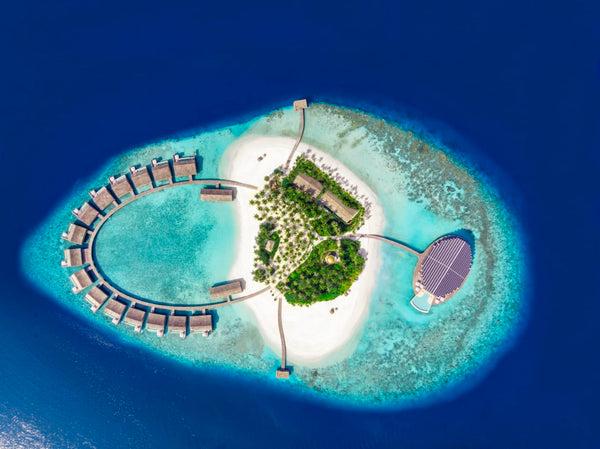
An atoll is a ring of coral reef with islands scattered around it. A lagoon is the shallow, sheltered water between an island and its outer reef, usually sandy and calm, which makes it the natural classroom. A house reef is the coral reef you can swim to from the resort itself; where the lagoon ends, the reef drops away into deeper water.
A thila is a reef that rises from the sea floor inside an atoll, like an underwater hill; a giri is a similar pinnacle closer to the surface. A kandu is a channel, a gap in the atoll's outer reef where ocean water flows in and out with the tide. A drift dive is one where the current carries divers along the reef. Channels and drift dives are a large part of Maldivian diving, and they are not where beginners start.
A dhoni is the traditional Maldivian wooden boat. PADI, the Professional Association of Diving Instructors, is the training body whose standards this guide follows.
Start with the house reef
The best preparation for diving is snorkelling the house reef in the first day or two. A good house reef for a nervous swimmer has three things: a calm, shallow area to practise in, a clear place to get in and out, and a reef edge close enough to reach without a long swim.
Baros Maldives in North Malé Atoll shows what this looks like at its best. A sea wall a short way out makes a protected zone of coral patches and fish, and gaps in the wall lead out to the drop-off, where turtles and blacktip and whitetip reef sharks are regular. The resort runs one-hour private snorkel lessons in the calm lagoon, covering mask clearing and finning, and guided house reef tours. Wear something on the feet inside the wall, as there is broken coral.
Not every famous reef suits a nervous start. At Milaidhoo Maldives in Baa Atoll the house reef is outstanding and the water villas have steps down into the lagoon, but there can be real current at the reef edge. That suits a confident snorkeller, not somebody new to fins. Always ask the resort's water sports or dive team about the current before swimming out, and swim with a partner.
The try dive: PADI Discover Scuba Diving
A try dive is the step between snorkelling and a course, and PADI calls its version Discover Scuba Diving. Participants must be at least 10 years old, and there is no upper age limit. PADI says participants need not be expert swimmers, but should be comfortable in the water and able to keep themselves at the surface. Everyone fills in a medical questionnaire first, and some answers mean a doctor has to confirm fitness before the dive can go ahead (more on this below).
The experience starts with a short briefing and practice in shallow, calm water to a maximum of 6 metres. Then comes an optional dive in open water with the instructor, to a maximum of 12 metres. Divers Baros Maldives, for example, runs its try dive with a PADI instructor around the house reef in about two hours.
The dive also counts. Tell the dive centre beforehand, and the instructor can add the skills that let it count towards the PADI Open Water Diver course, provided the full course starts within 12 months.
For children who are younger still, PADI's Bubblemaker programme takes children from 8 years old, using real scuba gear in water shallower than 2 metres, with a PADI professional supervising.
Learning properly: the PADI Open Water Diver course
The Open Water Diver course is the first full scuba certificate, and it lets a diver dive with a buddy, without an instructor.
The course has three parts:
- Knowledge development, the theory, done through PADI eLearning online or in a classroom.
- Confined water, basic skills practised in a pool or calm shallow water with an instructor.
- Open water dives, four of them, with the instructor.
PADI says the course can be completed in as little as two to four days. Before starting, students need to float or tread water for 10 minutes without aids and swim 200 metres without aids, or 300 metres with mask, fins and snorkel. Certified Open Water Divers may dive to 18 metres.
The minimum age is 10. Junior Open Water Divers aged 10 and 11 are limited to 12 metres and must dive with a certified parent or guardian or a PADI professional; those aged 12 to 14 may go to 18 metres with a certified adult. At 15 it becomes the adult certificate.
Two choices save holiday time. One is doing the eLearning at home before flying. The other is a referral: doing the theory and the pool sessions with a PADI dive centre at home, then taking the referral form to a dive centre in the Maldives for the four open water dives. PADI says those four dives usually take about a day and a half, and the referral stays valid for 12 months from the last training session.
Above Open Water sits Advanced Open Water Diver, which takes divers aged 15 and over to 30 metres. That matters here, because Maldivian law limits recreational diving to 30 metres.
What a good dive centre offers a beginner
A superb reef does not guarantee a good dive centre, so put these questions to the centre before booking.
- Its PADI rating. Ask whether it holds a PADI 5 Star rating.
- Where the training dives happen. A centre that can teach in a calm lagoon and run the first open water dives on a gentle house reef keeps boat time short and nerves low.
- Group size and fit. Ask how many students each instructor takes, and expect time spent fitting the mask and wetsuit.
- Medical back-up. Ask where the nearest doctor and the nearest recompression chamber are. A recompression chamber treats decompression illness, the rare but serious injury that can follow a dive.
Two resorts close to Malé show what a strong set-up looks like. Divers Baros Maldives is a PADI Five-Star Gold Palm Resort Dive Centre that has operated on Baros Maldives since 1979, with a house reef that slopes gently to about 20 metres and a set of depth limits by level on its own reef map. Dive Bandos at Bandos Maldives, also in North Malé Atoll, is a PADI 5 Star IDC centre, which means it also trains instructors, and the island's medical clinic has in-house dive doctors and nurses and its own decompression chamber. In Malé itself, ADK Hospital opened a decompression chamber in 2023.
House reefs, lagoons and the sites beginners use
Diving in currents is a fact of life in the Maldives, and the channels are where they run hardest. Dive teams can still choose reefs without current, which is where students belong.
North Malé and South Malé atolls are the closest to the airport. The Kuda Giri wreck in South Malé Atoll is an easy wreck dive with a shallow reef beside it for the safety stop, a good early outing for a newly certified diver.
Some names belong later. Fish Head in North Ari Atoll is a thila dive for advanced and experienced divers, done up-current, where the fish gather. It is a reason for a second trip.
For the animals themselves, the guide to what you will see on a reef, and when, covers the atolls one by one.
The best time of year to learn
The drier north-east monsoon runs roughly from December to April. The sea is usually calmer and visibility often exceeds 30 metres, which makes this the easier season for a first course.
The wetter south-west monsoon runs roughly from May to November. The surface can be rougher on some days, and more plankton in the water lowers visibility. That same plankton brings mantas and whale sharks, which are more likely to appear in these months.
The water is warm all year, and a thin wetsuit of about 3 millimetres is comfortable in any month. Either season works; with a choice, the drier months make learning easier.
Health, fitness and the medical form
Every PADI programme starts with the Diver Medical Participant Questionnaire, developed by diving doctors together with the Undersea and Hyperbaric Medical Society and the Divers Alert Network (DAN). Page one has ten questions. Answer no to all of them and no medical examination is needed. Some yes answers lead to a short second set of questions, and a yes there, or to certain page-one questions, means a doctor must approve diving before training can begin.
The questions cover heart, lung and blood problems, fitness, ear and sinus trouble, surgery in the past 12 months, prescription medicines and more. One question simply asks whether the diver is over 45, so many travellers in their late forties and fifties will reach the second page. Anyone who might answer yes should download the form from PADI and take it to a doctor at home, well before the trip.
Flying after diving
Diving leaves extra nitrogen in the body, and flying too soon afterwards raises the risk of decompression illness. DAN's guidelines set minimum surface intervals between the last dive and the flight:
- At least 12 hours after a single dive without decompression stops.
- At least 18 hours after several dives a day or diving over several days.
- Substantially longer than 18 hours after dives with compulsory decompression stops.
A beginner on a course is diving on several days, so the 18-hour figure is the one to plan around: the last dive has to finish at least 18 hours before take-off, which rules out diving on the day of departure and, for an early flight, the day before as well. Those hours are a good time for snorkelling at the surface. For resorts reached by seaplane or domestic flight, the transfer back to Malé is part of the journey home, so ask the dive centre how it times the last dive.
Choosing a resort for learning to dive
For a nervous first-timer or a short stay, a resort near Malé reached by resort speedboat keeps travel short and leaves more of the trip for the water. Baros Maldives is 25 minutes from Velana International Airport by its own speedboat, and Bandos Maldives is 10 minutes, so neither depends on the seaplane timetable.
For a confident snorkeller, the reef matters most. For a beginner set on certification, the dive centre matters most: its rating, a sheltered training site and a calm lagoon for the confined water sessions. Allow at least a few clear days for the course, plus at least 18 hours without diving before flying.
Farther atolls reward divers once they can dive. Baa Atoll, a UNESCO Biosphere Reserve, is reached from Malé by seaplane or domestic flight, and seaplanes in the Maldives fly in daylight only, so the time an international flight lands decides how and when the transfer runs. Milaidhoo Maldives, a 35-minute seaplane ride away, has a PADI Five Star dive centre and Hanifaru Bay, the famous manta feeding ground, nearby. Diving is banned inside Hanifaru Bay, so every visit there is on snorkel, which suits a beginner as well as an expert.
For underwater restaurants and villas, and other ways to see the reef without getting wet, there is a separate guide.
Who this suits
The Maldives is a fine place to learn, because the water is warm, the reefs are close and dive teams can choose calm sites. It suits beginners who start with the house reef, give a course three or four unhurried days and pick a resort for its reef and dive centre rather than for the reputation of sites they are not yet ready for. It suits less well anyone hoping to learn and dive the famous channels in the same week; those are a reason to come back.
Common questions
Can you scuba dive in the Maldives without a licence?
Yes. A PADI Discover Scuba Diving experience lets non-certified swimmers aged 10 and over dive with an instructor, to a maximum of 12 metres in open water, after a medical questionnaire and practice in shallow water. It is not a certificate, but it can count towards the PADI Open Water Diver course if started within 12 months.
How long does it take to get PADI certified in the Maldives?
PADI says the Open Water Diver course can be completed in as little as two to four days. Doing the eLearning theory at home first saves time on the island. With a referral, where theory and pool sessions are done at home, the four open water dives usually take about a day and a half.
Is the Maldives good for beginner divers?
Yes, provided the site matches the diver. Warm water, close reefs and sheltered lagoons make learning comfortable, and dive teams can choose reefs without current for students. The strong-current channels and thilas the Maldives is famous for are dives for later, once certified and experienced.
What is the best month to learn to dive in the Maldives?
The drier north-east monsoon, roughly December to April, usually brings calmer seas and visibility often beyond 30 metres, which makes learning easier. The wetter months from May to November can be rougher at the surface and bring more plankton, lower visibility and more mantas and whale sharks.
How long after diving can you fly from the Maldives?
DAN recommends at least 12 hours after a single dive without decompression stops and at least 18 hours after several dives a day or diving over several days. A beginner on a course falls in the second group, so the last dive must finish at least 18 hours before take-off, which rules out diving on the day of departure.
Do I need a medical certificate to dive in the Maldives?
Not always. Every PADI programme starts with the Diver Medical Participant Questionnaire. Answer no to all ten questions on page one and no examination is needed. A yes can mean a doctor must sign the form before diving, so anyone unsure should take it to a doctor at home before travelling.