Maldives Marine Life by Atoll and Season: Where to See Mantas, Whale Sharks, Turtles and Sharks

In this article
Updated October 2026
What a traveller sees underwater in the Maldives depends far more on the atoll and the month than on luck. Turtles, reef sharks and big schools of reef fish turn up almost everywhere, all year; manta rays follow the monsoon from one side of the atolls to the other, whale sharks stay in South Ari Atoll all year, and tiger sharks gather off one island in the deep south. Pick the animal first, then the atoll, then the month.
How the Maldives works underwater
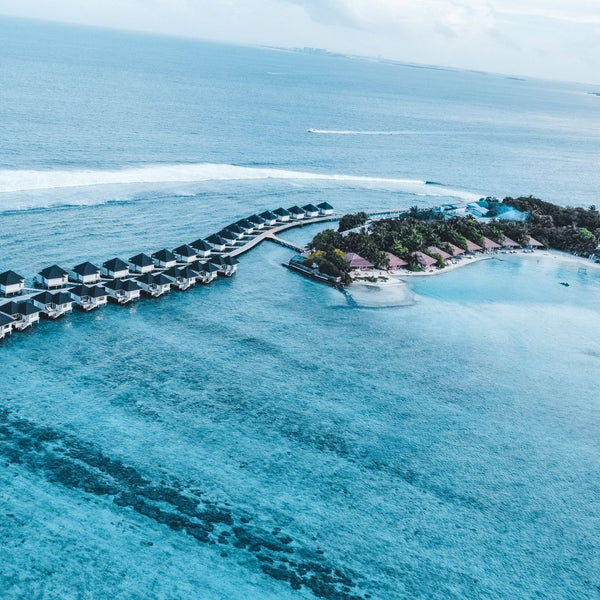
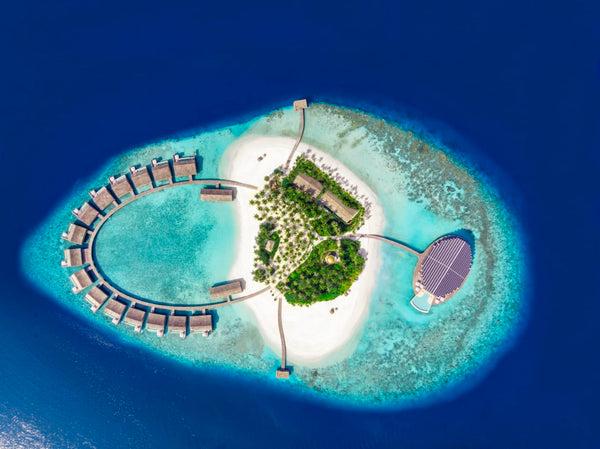
An atoll is a ring of coral reef with islands scattered around it. Each one encloses a lagoon, the shallow, sheltered water inside the reef. Inside sit thilas: a thila is a reef that rises from the atoll floor and stops short of the surface, and many of the best dives are on them.
Around the rim, gaps called kandus, or channels, let the open ocean flow in and out of the atoll with the tide. That flow brings in plankton, clear water and the bigger animals. A drift dive is one where the diver lets the current carry them along the reef, and the channels are where most drift dives happen, which makes them a place for experienced divers.
A house reef is the coral reef you can swim to from the resort itself. Some are outstanding and some are thin, and that shapes a holiday for anyone who wants to snorkel without a boat. Trips further out go on a dhoni, the traditional Maldivian wooden boat, now motorised.
The monsoon pattern, and why it moves the mantas
The Maldives has two seasons, named after the winds. The drier north-east monsoon runs roughly from December to April. The wetter south-west monsoon runs roughly from May to November.
The north-east monsoon is the season for clear water. Visibility of 30 metres or more is common and seas are calmer.
The south-west monsoon brings more rain, more wind and more plankton. The water is cloudier, but plankton is food, and the mantas and whale sharks come for it.
The rule is simple. Mantas follow the plankton downwind: in the north-east monsoon to the western side of the atolls, in the south-west monsoon to the eastern side. That is why the famous wet-season manta sites, Hanifaru Bay in Baa Atoll and Manta Point in North Malé Atoll, sit on the eastern side of their atolls.
Manta rays
By 2019 the Manta Trust, the charity that studies mantas here, had identified close to 5,000 individual reef mantas in the Maldives, along with several hundred of the larger oceanic manta.
Mantas are seen in two ways. At cleaning stations, they hover over a coral head while small fish pick parasites from their skin, often for long stretches, which makes for calm, close viewing. At feeding sites, they sweep through clouds of plankton, sometimes in dozens.
Manta Point in the south-east of North Malé Atoll is a cleaning station close to Malé, at its best in the south-west monsoon. Sightings are never certain anywhere: tide and current decide whether the mantas come in on a given day.
Whale sharks and the South Ari Marine Protected Area
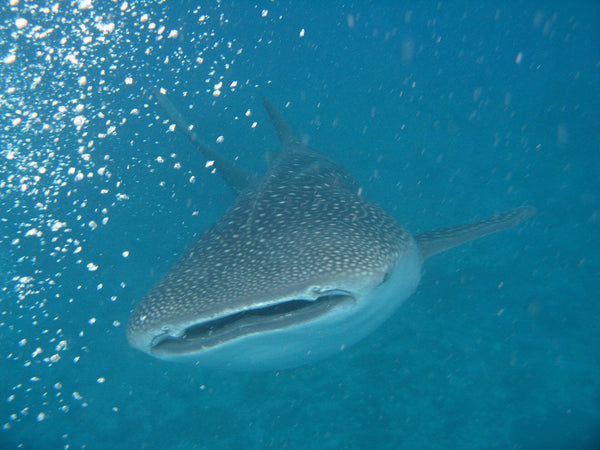
The South Ari Marine Protected Area, set up in 2009 along the southern rim of Ari Atoll, is one of very few places in the world where whale sharks are seen in every month of the year. The animals here are mostly young males, about nine in every ten, and researchers with the Maldives Whale Shark Research Programme believe they use the area as a nursery, feeding and growing along the outer reef. The local islands of Dhigurah and Maamigili lie close by.
Boat trips search the reef edge, and swimmers slip into the water when a shark is found, so most encounters are on snorkel, at the surface.
The code of conduct is short. Enter the water quietly, about 20 metres away. Stay at least 3 metres from the body and 4 metres from the tail. Never touch the shark, and never swim in front of it. Boat strikes are a major threat to these sharks, so the area's management plan now requires excursion boats to fit propeller guards.
LUX* South Ari Atoll sits beside the protected area, and its own boat goes out to the whale sharks three mornings a week, led by the resort's marine biology team. Its own house reef is thin, with a sandy lagoon, so the best snorkelling there is by boat.
Baa Atoll and the Hanifaru Bay mantas
Baa Atoll, north-west of Malé, became a UNESCO Biosphere Reserve in 2011, with Hanifaru Bay as one of its core protected zones. Hanifaru is a small, shallow bay where, in the south-west monsoon, plankton collects and the mantas arrive to feed. On one day in July 2019 the Manta Trust counted 116 individual reef mantas in the bay. Whale sharks visit too.
The season runs roughly from May to November, and the Manta Trust's 2019 survey found its busiest months in July and August.
The rules are strict. Hanifaru has been a Marine Protected Area since 2009, and since 2012 diving has been banned inside the bay, so every visitor snorkels. Groups go in with a certified Hanifaru guide, the number of boats and people in the bay at one time is capped, time in the water is limited, and rangers enforce it all. Operators must keep to set access times and routes.
Two Baa Atoll resorts show the range. Four Seasons Resort Maldives at Landaa Giraavaru, 35 to 40 minutes from Malé by seaplane, runs a Marine Discovery Centre with resident marine biologists, a turtle rehabilitation centre and a Manta-on-Call service that alerts guests when mantas are spotted nearby. The resort has backed the Maldivian Manta Ray Project, the founding project of the Manta Trust, since it began in 2005. Its house reef is modest.
Milaidhoo Maldives, a small island about 35 minutes by seaplane, runs three guided trips a week to Hanifaru in season, has its own marine biologist, and has a house reef that is outstanding in its own right, with very large schools of fish along the drop-off.
Seaplanes in the Maldives fly in daylight only, so an evening landing at Velana International Airport in Malé rules out a same-day seaplane to Baa.
North and South Malé Atolls
The two atolls around the capital are the easiest to reach from the airport.
North Malé has a little of everything. HP Reef is a thila covered in soft corals, with schools of snapper and jacks, eagle rays and grey reef sharks. Banana Reef is known for its wealth of reef fish. The Maldives Victory, a cargo ship that sank in 1981, is now coated in coral and fish.
The 2024 bleaching was hard on these central atolls, so reef quality varies sharply from island to island.
Ari Atoll beyond the whale sharks
Ari is a big atoll west of Malé with a long list of dive sites. Maaya Thila in North Ari is a favourite night dive, and by day grey reef sharks and eagle rays circle the pinnacle. In the north-east monsoon, the mantas move to the western side of the atoll. With the whale shark area in the south, Ari suits anyone who wants big animals and variety on one stay.
Vaavu Atoll
Vaavu is a quiet atoll south of South Malé, known above all for its channel dives. Fotteyo Kandu is a channel dive with caves and overhangs, where an incoming tide brings grey reef sharks, eagle rays and jacks. It is a strong-current, advanced dive.
Vaavu is also known for night dives at a jetty where nurse sharks, stingrays and jacks gather at a feeding station. It is a spectacle, but feeding wild sharks remains controversial, and some divers prefer to skip it.
Lhaviyani Atoll
Lhaviyani, north of Malé, is a good all-round atoll. The Shipyard is a pair of sunken fishing vessels off the island of Felivaru, now covered in soft coral and home to resident nurse sharks. A thila inside the atoll holds a manta cleaning station, and the channels draw grey reef sharks on the incoming tide. The Olive Ridley Project runs one of its sea turtle clinics here. Which of its resorts have a reef to swim to, and which go out by boat, is covered in the Lhaviyani Atoll resort comparison.
Fuvahmulah and the tiger sharks
Fuvahmulah is unusual: a single island that forms an atoll on its own, in the open ocean just south of the Equator. It is reached by domestic flight from Malé.
The main draw is the tiger shark. At Tiger Harbour, a shallow plateau just outside the island's harbour at about 10 metres, tiger sharks are seen all year. Other dives off the island bring thresher sharks, hammerheads, silvertips, oceanic mantas and the occasional whale shark. Strong currents, waves and depth on the outer sites call for experience, and this is a trip for confident divers rather than a first dive.
The far south and the far north
Addu, the southernmost atoll, has the wreck of the British Loyalty, an oil tanker lying inside the atoll's lagoon.
The far south matters for another reason. In the 2024 bleaching, surveys in Huvadhoo Atoll, north of Addu, found no detectable coral death, while the central atolls lost a large share of their coral. Scientists see the southern reefs as a possible refuge from heat.
The far north, Haa Alifu and Haa Dhaalu, sees fewer visitors than the central atolls and is reached by domestic flight from Malé, so the trade-off is time in transit.
Turtles
Five of the world's seven sea turtle species have been recorded in the Maldives, and two are the ones snorkellers meet: the green turtle and the hawksbill. Both nest on beaches across the country.
The biggest threat is ghost gear, lost or abandoned fishing nets that drift into the atolls and trap turtles. The Olive Ridley Project, the charity that treats injured turtles here, runs clinics in Baa, Lhaviyani and Raa atolls.
Sharks
Reef sharks are a regular sighting in the Maldives. Grey reef sharks gather at channel mouths on the incoming tide, and nurse sharks turn up on night dives and around wrecks.
The Maldives banned shark fishing in 2010, then in November 2025 reopened a licensed fishery for one deep-water group, the gulper sharks. Bigger species, the tiger, thresher and hammerhead, belong mainly to Fuvahmulah and the open ocean.
Dolphins
Up to 22 species of whale and dolphin occur in Maldivian waters. Spinner dolphins are the most abundant. They feed in the open ocean at night and move into the atolls to rest by day, often in the reef channels, which is why resorts run dolphin trips early or late in the day, watched from the boat.
The state of the coral: bleaching and recovery
Coral bleaching happens when the sea stays too warm for too long and corals expel the algae that feed them, turning white. If the heat lasts, the coral dies.
In 1998, roughly nine in ten corals died. In 2016, the Maldives Marine Research Institute found 73 per cent of corals bleached, and about six in ten died. Recovery after 2016 was fairly quick: one study found hard coral cover on its survey reefs largely back to pre-bleaching levels by 2023.
Then came 2024, part of the fourth global bleaching event. Sea temperatures reached a record 31.5 degrees Celsius. In the central atolls, Ari, North and South Malé and Vaavu, a 2026 study found that about 27 per cent of coral died on lagoon reefs and about 41 per cent on outer reefs. Branching and table corals took the heaviest losses; rounded, boulder-shaped corals survived better.
What this means on holiday is mixed. The fish, turtles, sharks and mantas are still there to see. But some reefs that looked like gardens of table coral a few years ago are flatter now, and house reef quality varies a great deal from island to island. Asking about the house reef before booking matters more than ever.
Matching the animal to the trip
For mantas in big numbers, Baa Atoll between May and November. For whale sharks at any time of year, South Ari. For the clearest water and channel diving, December to April in North Malé, Ari or Vaavu. For tiger sharks, Fuvahmulah, with a domestic flight and some diving experience. For turtles and reef sharks, a resort with a good house reef, in any month.
New to diving? The guide to learning to dive in the Maldives covers try dives and PADI courses (PADI, the Professional Association of Diving Instructors, is a dive training organisation whose courses many dive centres here teach). To see the reef without getting wet, read the guide to underwater restaurants and villas.
Who this suits
The Maldives rewards travellers who plan around the animal. A honeymoon couple who want mantas should go to Baa in the south-west monsoon and accept some rain. A family who want calm water and turtles off the beach should choose the house reef first and the atoll second. Divers chasing big sharks should look south. Anyone who books on villa photos alone, without asking what lives off the beach, is leaving the best part of the Maldives to chance.
Common questions
When is the best time to see manta rays in the Maldives?
Mantas are seen all year, but they move with the monsoon. From May to November they gather on the eastern sides of the atolls, including Hanifaru Bay in Baa Atoll, where feeding peaks around July and August. From December to April they shift to the western sides. Sightings depend on tide and current.
Can you see whale sharks in the Maldives all year?
Yes, in the South Ari Marine Protected Area along the southern rim of Ari Atoll, one of very few places where whale sharks stay year-round. Most are young males. Encounters are mostly on snorkel, and swimmers must keep at least 3 metres from the shark and never touch it.
Can you dive at Hanifaru Bay?
No. Diving has been banned inside Hanifaru Bay since 2012, so every visitor snorkels. Groups enter with a certified guide, the number of boats and people at one time is capped, time in the water is limited and rangers enforce the rules. The season runs roughly from May to November, and the bay is usually quiet outside it.
Are the reefs in the Maldives still good after coral bleaching?
It depends where. The 2024 bleaching killed a large share of coral in the central atolls, especially branching and table corals, while surveys in Huvadhoo Atoll in the far south found no detectable coral death. Reefs largely recovered after 2016, and fish life, turtles and sharks remain. House reef quality now varies a lot, so check the specific island.
Where can you see tiger sharks in the Maldives?
At Fuvahmulah, a single-island atoll in the deep south reached by domestic flight from Malé. Tiger sharks are seen year-round at Tiger Harbour, a shallow plateau just outside the island's harbour at about 10 metres. Thresher sharks, hammerheads and oceanic mantas appear on other dives. Currents and depth on the outer sites call for experienced divers.