Soneva Fushi or Soneva Jani? The Jungle Island and the Lagoon Island Compared

In this article
Updated October 2026
Choose Soneva Fushi for the reef and the jungle, and Soneva Jani for the lagoon and the villa slides. Soneva Fushi is a large, wooded island in Baa Atoll with a strong house reef and villas hidden among the trees along the beach. Soneva Jani sits in a private lagoon 5.6 kilometres long in Noonu Atoll, where most villas have a slide and there is no coral beneath the decks.
Two islands from the same hand
An atoll is a ring of coral reef with islands scattered around it, and the Maldives is a chain of them. Baa and Noonu both lie north of Malé, with Noonu the further north of the two. A lagoon is the shallow, sheltered water between an island and its outer reef, and it is the lagoon that separates these two resorts more than anything else.
Much is shared. Both have an observatory with a resident astronomer, an open-air Cinema Paradiso, a Chocolate Room and a Cheese Room, a wine cellar, a children's club called The Den, a spa under the Soneva Soul name and dives run by Soleni Dive Centre. A guest who loves one will recognise the other.
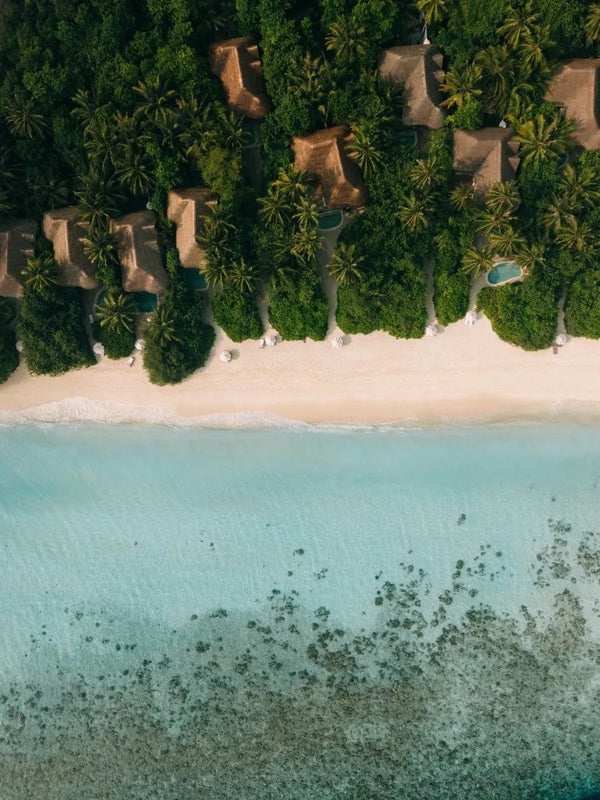
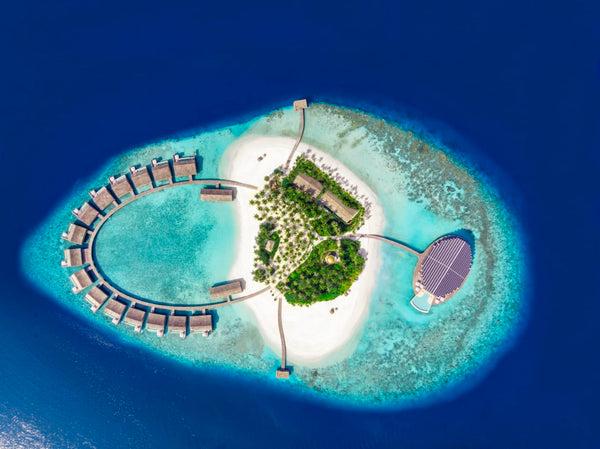
What differs is the ground underfoot. Soneva Fushi is a land island: jungle, sandy paths, beaches and villas set back in the trees. Soneva Jani is a water island: the main event is the lagoon, and the villas, the observatory and the cinema all stand over it.
Soneva Fushi: the jungle island in Baa Atoll
Soneva Fushi stands on Kunfunadhoo, a large island in Baa Atoll, which UNESCO lists as a Biosphere Reserve. Soneva calls it "the original barefoot island built around nature", and shoes come off on arrival. The interior is thick with vegetation, paths run under the trees, and the villas are spaced along the beach with the jungle behind them.
Most villas are on land. They run from the 1 Bedroom Crusoe with Pool, at 145 square metres, through the Crusoe Suites, the Soneva Fushi Villa Suites and the 1 Bedroom Soneva Fushi Family Suite with Pool, at 360 square metres, to beach villas, residences and estates of up to nine bedrooms. Nearly every one has its own pool, and the larger villas suit families or groups who want a house rather than a room.
The overwater villas are the Water Reserves. The 1 Bedroom Water Reserve with Slide is 585 square metres and the 2 Bedroom version 857, and each has its own pool and a slide into the lagoon. Soneva fits its overwater villas with retractable roofs. Anyone set on sleeping over the water at Soneva Fushi is choosing between these two.
Soneva Jani: the lagoon island in Noonu Atoll
Soneva Jani stands on Medhufaru, in Noonu Atoll. Its private lagoon is 5.6 kilometres long, warm, shallow and sandy, and the resort was built around it rather than around a reef. Soneva Jani also keeps its clocks one hour ahead of Malé for more daylight, switching back to Malé time during Ramadan.
Here the overwater villas are the heart of the island. The Water Reserves come with one, two or four bedrooms, from 555 square metres for the 1 Bedroom Water Reserve with Slide to 1,421 for the 4 Bedroom Sunset Water Reserve with Slide, and each has a slide into the sea. The overwater villas also have retractable roofs.
On land there are the Island Retreats and Island Reserves, with two to four bedrooms and slides of their own, from the 2 Bedroom Island Retreat with Slide, at 446 square metres, upwards, and the 1 Bedroom Beach Hideaway, 480 square metres on the beach. Every villa has its own pool.
The house reef: the biggest difference
A house reef is the coral reef you can swim to from the resort itself. On this point the two islands are far apart.
Soneva Fushi's house reef is strong. It is a real reef with good marine life, but on an island this size it comes in good stretches rather than a full circuit. The best known stretches lie off the two sea-facing restaurants, where guests report blacktip reef sharks in numbers late in the afternoon, along with turtles and mantas. Entry is over rock and coral in places, so reef shoes matter, and the sunrise side is harder to get into than the sunset side.
Soneva Jani's house reef is thin where the villas are. The villas were built over sand on purpose, so there is no reef off the steps, and snorkellers who expect coral from the deck are disappointed. The house reef proper is a short boat ride away, the boat goes out daily, and the coral there is healthy. In the lagoon itself, rays, turtles and young sharks drift through, and Medhufaru Lagoon Snorkelling is on the resort's programme.
Beyond the house reefs, both islands send divers and snorkellers out by boat with Soleni Dive Centre. Newcomers to diving can read the guide to Maldives diving for beginners before choosing a course.
Mantas, Hanifaru Bay and the seasons
Baa Atoll has something Noonu does not. Hanifaru Bay, a small bay on the east side of the atoll, draws one of the largest gatherings of manta rays in the world, as the rays come to feed on plankton carried in by the tide. Only snorkelling is allowed there, and the number of visitors is limited. Soneva Fushi runs manta snorkelling trips into the plankton-rich waters nearby.
The season is set by the monsoons. The wetter south-west monsoon runs roughly May to November, bringing more rain and the currents that feed the mantas, and that is when Baa's manta gatherings happen. The drier north-east monsoon runs roughly December to April, with calmer, more settled days. No one can promise a sighting, since the mantas follow the plankton. The guides to the best time to visit the Maldives and the green season cover the months in detail, and Maldives marine life by atoll and season covers what turns up where.
Getting there, and arriving late
Seaplanes in the Maldives fly in daylight only, because they take off from and land on water. Both islands are seaplane islands, and both have a second route for anyone who lands too late for one.
To Soneva Fushi the seaplane takes about 30 minutes from Velana International Airport. The other way is a domestic flight to Dharavandhoo, the airport island in Baa Atoll, followed by a short speedboat ride. Domestic flights from Malé to Dharavandhoo take about 30 to 40 minutes and run into the late evening.
To Soneva Jani the seaplane takes about 40 minutes. The other way is a domestic flight of about 30 minutes on a wheeled aircraft to Maafaru, the airport in Noonu, and then about ten minutes by the resort's speedboat. Those flights also run into the late evening. Soneva advises against a speedboat all the way from Malé, which takes hours and can be rough.
On both seaplane routes the luggage allowance is 25 kilograms per person including hand luggage, and the seaplane is operated by Manta Air. Going home, the same daylight rule applies, so a late-night flight back to India often suits the domestic route better. Airlines change their timetables, so check the route against the landing time before booking international flights.
Eating and drinking
Both islands have long menus, and both keep the Chocolate Room and the Cheese Room open through the day, alongside a wine cellar for rare and organic wines and Primitive, a Maldivian dinner cooked over open flames on the beach.
Soneva Fushi spreads its venues across the jungle and the shore. Out of the Blue is suspended above the sea and serves Asian cooking. Fresh in the Garden is set above the organic gardens. Flying Sauces is a moving meal in the treetops. So Hands On by Chef Akira is a quiet sushi counter serving omakase, Bespoke cooks teppanyaki, Once Upon a Table serves a tasting menu in a small dining room, and Out of the Sea is a seafood shack on the shoreline. Down to Earth, on the sunrise side, the Pasta Counter and the Mihiree Mithaa café cover the easier meals.
Soneva Jani leans towards the water. Director's Cut stands above the lagoon with Japanese cooking and silent cinema, and holds a teppanyaki grill and the Irori Grill, where guests gather around a charcoal hearth. Crab Shack serves Sri Lankan seafood with views across the lagoon, Saji cooks Indonesian food, Chill serves Maldivian and Peruvian dishes at long lunches by the water, and the Asian Kitchen in the Garden and The Lagoon Club round out the list. Tipsy mixes cocktails to order and sends them by tuk tuk to wherever guests happen to be.
Evenings: the observatory and Cinema Paradiso
Both observatories house a 16-inch telescope that rises from the ground, and both are run by resident astronomers who guide guests around the night sky. At Soneva Jani the observatory stands over the lagoon, and So Starstruck sets dinner around it. At Soneva Fushi the observatory, with its domed roof, sits among dense trees on the island itself.
Cinema Paradiso is the other ritual. At Soneva Fushi classic films play beneath the night sky with the sound of waves nearby. At Soneva Jani the screen sits above the lagoon. Book both early in the stay.
Children and The Den
Both islands are built to take children seriously, and both have a club called The Den.
At Soneva Fushi, The Den covers more than 1,365 square metres. It has two shallow pools, an eight-metre-tall pirate ship, giant piano keys built into the floor, a Lego and Duplo room, a library, a music room, a dressing-up room and a cinema, with cooking classes on the programme. It is a technology-free zone, and teenagers have a lounge of their own and a weekly programme that includes stargazing.
At Soneva Jani, The Den runs over two storeys, with a zipline through cascading waterfalls, a pool, a pirate ship, musical piano steps, a Lego and craft area, a cinema and a kitchen for cooking classes, plus a sensory area for toddlers. Teenagers get the Cave Bar, with music and mocktails, and a roof deck with a music room, a telescope deck, and pool and foosball tables.
The practical difference is the water. Soneva Jani's shallow sandy lagoon and the villa slides make the whole island a playground. Soneva Fushi gives children the jungle, the beaches and a reef worth a first snorkel.
The spa and the rest of the day
Soneva Soul is the wellbeing name on both islands. At Soneva Fushi the treatments include an Ayurveda Journey and Float to Sleep, a float in warm mineral-rich water followed by sleep therapy, and the island has a Glass Studio where recycled glass is reworked into handmade pieces. At Soneva Jani the Soneva Soul programme runs to Pilates, aerial yoga, pranayama and Ayurvedic marma massage, with paddleboarding, kayaking and sailing on the lagoon. On both islands, Drift and Dine is a castaway picnic prepared by a private chef on a quiet stretch of sand.
Splitting a stay between the two
A split stay is practical, because Soneva runs transfers between the islands. The seaplane from one to the other takes about 20 minutes. A boat also makes the crossing, and Soneva in Aqua, the group's yacht, sails between them over four to five hours, which Soneva suggests as a two-day, one-night voyage.
The case for splitting is simple: Soneva Fushi for the reef and the mantas, Soneva Jani for the lagoon and the slides. The case against is time. Each island deserves several nights, and each move between islands means packing, checking out and settling in again, so a split makes sense on a longer trip and much less on a short one.
Who each island suits
Soneva Fushi suits snorkellers, divers and families who want a real reef, a jungle to explore and a beach villa with space around it, and it suits manta hunters in the south-west monsoon best of all. Soneva Jani suits couples and families who came for the water itself: a lagoon to walk into, a slide from the villa and an observatory over the sea. Anyone whose holiday is the reef should not choose Soneva Jani, and anyone whose dream is waking above the lagoon every morning will find Soneva Fushi's overwater choice narrow.
Common questions
Which is better, Soneva Fushi or Soneva Jani?
It depends on the water. Soneva Fushi, in Baa Atoll, has a strong house reef, jungle and villas set back from the beach. Soneva Jani, in Noonu Atoll, has a 5.6-kilometre lagoon, overwater villas with slides and a thin reef by the villas, with the house reef a short boat ride away. The reef decides it.
Does Soneva Jani have a good house reef?
Not by the villas. They stand over sand on purpose, so there is no coral off the steps. The house reef is a short boat ride away, the boat runs daily and the coral there is healthy. Rays, turtles and young sharks pass through the lagoon, which the resort snorkels on its Medhufaru Lagoon Snorkelling trips.
How do you get from Soneva Fushi to Soneva Jani?
By seaplane in about 20 minutes, by boat, or on Soneva in Aqua, the group's yacht, which takes four to five hours and is suggested as an overnight voyage. Soneva arranges the transfers between its two islands, which makes a split stay practical on a longer trip.
Can you reach Soneva Fushi or Soneva Jani after a late flight?
Seaplanes fly in daylight only, but both islands have a later route. For Soneva Fushi it is a domestic flight to Dharavandhoo and a short speedboat. For Soneva Jani it is a domestic flight to Maafaru and about ten minutes by speedboat. Check the timetable for your landing time before booking.
Which Soneva resort is better for children?
Both have The Den. Soneva Fushi's covers more than 1,365 square metres, with two shallow pools and a pirate ship. Soneva Jani's runs over two storeys, with a zipline, a pirate ship and a teen roof deck. Soneva Jani adds a shallow lagoon and slides, Soneva Fushi jungle and a reef.
Do both Soneva resorts have an observatory?
Yes. Each has a 16-inch telescope that rises from the ground and resident astronomers who guide guests through the night sky. Soneva Jani's observatory stands over the lagoon, with dinner set around it at So Starstruck, while Soneva Fushi's sits among the trees under a domed roof. Both also run Cinema Paradiso.