





Local Island or Resort Island? What Your Money Actually Buys in the Maldives

A guesthouse on Maafushi costs around $90–$130 a night. A comparable resort room starts at roughly four times that before you've paid for the transfer. The gap is real, and so are the three things you trade for it: no alcohol on the island, swimwear only on one designated beach, and no house reef you can walk into from your room.
Realistic daily spend, per person, all in
Accommodation, food, transfers and a moderate excursion budget. Indicative 2026 ranges.
That trade is excellent value for some travellers and a ruined holiday for others. Here is how to tell which one you are.
The four things that actually change
Everything else is detail. These four are the decision.
Local islands are dry. Under Maldivian law alcohol cannot be bought, sold or consumed on any inhabited island, without exception. No wine with dinner, no beer after snorkelling. The legal workaround is a floating bar: a licensed boat moored offshore that you reach by a short speedboat ride, typically $30–$60 per person for an evening with drinks included. It works, and it is a normal part of local island life, but it is an outing rather than a nightcap.
In the village, at the shops, on the ferry and on any beach that isn't the designated one, cover shoulders and knees. T-shirts and shorts are fine for everyone. On the bikini beach, ordinary swimwear is fine. Topless sunbathing is illegal anywhere in the Maldives, including resorts.
This is the one people underestimate. On a resort island the entire beach is yours. On a local island you get one signposted stretch, often compact and shared. On Maafushi the bikini beach is a five-minute walk from most guesthouses, has loungers and a café, and is perfectly pleasant. It is not a private beach outside your door, and some couples find the arrangement more restrictive than they expected.
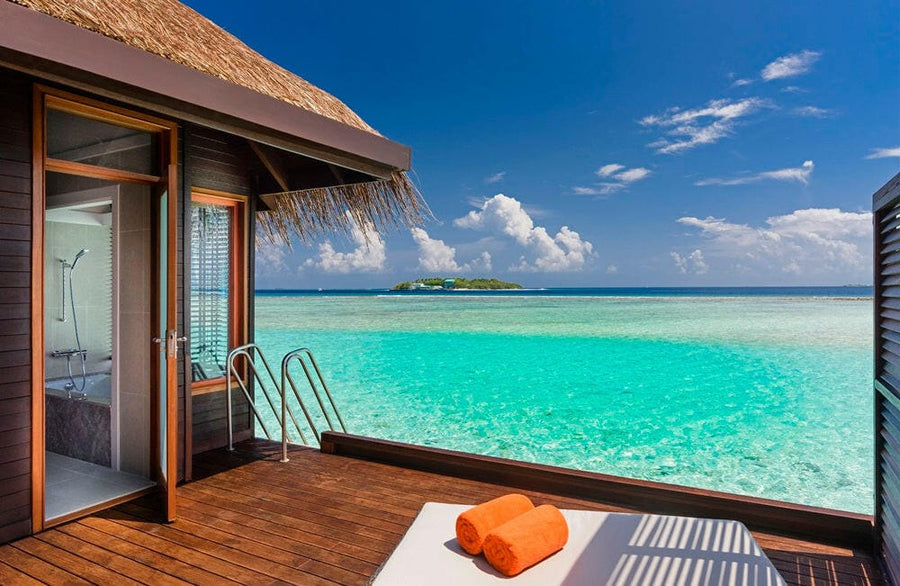
Most resorts are built on their own reef. Most local islands are not, so snorkelling means a boat trip rather than a five-minute swim. Some islands are exceptions, which is why the island you pick matters more than the guesthouse you pick.
What this actually costs
| Local island | Resort island | |
|---|---|---|
| Room per night | $50–$150; a good Maafushi double with AC, pool and breakfast runs $90–$130 | $350–$800+ at entry and mid-market |
| Transfer, per person one way | $20–$40 shared speedboat; $1.50–$3 public ferry | $100–$400 speedboat return; $400–$850 seaplane return |
| Green tax, per person per night | $6 | $12 |
| TGST | 17% | 17% |
| Service charge | 10%, legally required | 10%, legally required |
| Meals | $25–$40 a day eating locally | Meal plan, or resort prices |
| Realistic daily spend, per person | $60–$150 all in | $250–$600+ all in |
Figures are indicative 2026 ranges and vary by island, property and season. We confirm exact costs on every quote.
Three things worth pulling out of that table.
Green tax is genuinely lower on local islands. Guesthouses on inhabited islands with 50 or fewer registered rooms are charged $6 per person per night rather than the $12 resorts pay. Over five nights for two people that's $60 back in your pocket. Children under 2 are exempt either way.
The 10% service charge applies to guesthouses too. It is not a resort-only convention. Maldivian law requires every tourism business, guesthouses included, to levy at least 10% and distribute it among staff. Budget for it.
The transfer is where the saving is largest. A couple flying into Velana and taking a $30 shared speedboat to Maafushi spends $120 return. The same couple on a seaplane to Baa spends $1,000–$1,400.
Which island suits which traveller
The island choice matters more than the guesthouse choice. These four cover most of what people actually book.
| Island | Atoll | Getting there | Suits | The catch |
|---|---|---|---|---|
| Maafushi | Kaafu | 30–45 min speedboat from Malé | First-timers, short trips, anyone wanting choice of guesthouses and excursions | Busy and densely built. Shore snorkelling is limited and the beach is not the country's best |
| Thulusdhoo | Kaafu | Speedboat from Malé | Surfers. Coke's and Chickens are serious breaks | Wrong island if you don't surf. Swell is seasonal |
| Dhigurah | South Ari | Domestic flight to Maamigili plus boat, or long speedboat | Whale sharks, and a long genuinely beautiful beach | Further and costlier to reach. Quiet in the evenings |
| Fulidhoo | Vaavu | Speedboat or ferry from Malé | Couples wanting quiet. Nurse sharks and stingrays come to the shoreline | Very small. Little to do beyond the water |
Two more worth knowing: Rasdhoo and Ukulhas in North Ari are calmer than Maafushi with better reefs, and Thoddoo is greener and more agricultural than anywhere else on this list.
Getting there, and the Friday trap
Two ways to reach a local island, and the cheap one has a catch.
Shared speedboat
30 to 45 minutes to Maafushi, $20–$40 per person each way depending on operator, several departures daily including Fridays. Book it through your guesthouse rather than a third-party site.
Public ferry
Around $1.50–$3, roughly 90 minutes, and by far the cheapest way to move around the country. Buy tickets in person, not online.
Public ferries do not run on Fridays. Friday and Saturday are the Maldivian weekend and the working week starts Sunday. If you land on a Friday planning to ferry across, you will be booking a speedboat at short notice or spending a night in Malé. Plan the ferry legs around it.
Note too that public ferries only serve local islands. They do not go to resorts, ever.
The split stay, which is what we book most
The best answer for most first-time visitors is not one or the other.
Three or four nights on a local island, then two or three at a resort. You get the excursions, the local food and the cost base of a guesthouse, then finish with the beach, the house reef and the water villa photograph. Because the resort leg is short, you can afford a better resort than you could have booked for the full week.
It works particularly well for honeymooners on a fixed budget. Doing the resort segment last also means the transfer home is simpler, since you finish closer to Malé rather than starting there.
Moving from a local island to a resort usually means going back through Malé, so build the middle transfer into a morning rather than losing an afternoon to it.
Notes for Indian travellers
Vegetarian and Jain food. Local island cafés run to fried rice, noodles, curries and short eats. The variety is limited compared with a resort buffet, but guesthouses will cook to order if you tell them in advance rather than on arrival. Say it at booking, and say it again the day before.
No pork, and no alcohol imports. Both are prohibited nationwide. Don't pack duty-free bottles; they will be confiscated at Velana and returned when you leave.
Prayer times. Shops and cafés close briefly several times a day. It is short, but plan around it if you have a boat to catch.
Cash. Guesthouses and excursion operators take USD readily. Small cafés often prefer rufiyaa. Carry some of both.
Who local islands aren't for
Skip them if a drink with dinner is part of how you relax, because the floating bar is a scheduled outing rather than a habit. Skip them if the overwater villa is the point of the trip. Skip them if you want to walk from your room into a reef, unless you've chosen a specific island for that reason. Skip them on a honeymoon where privacy matters most, since a shared bikini beach and a village setting is the opposite of seclusion.
Take them seriously if the alternative is not coming at all, if you want to meet Maldivians rather than only see staff, if you're travelling with family who don't drink, or if you'd rather spend on diving and excursions than on a room.
Frequently asked questions
Is alcohol allowed on Maldives local islands?
No. Alcohol cannot be bought, sold or consumed on any inhabited island, including Maafushi and Thulusdhoo. Guesthouses and restaurants there do not serve it. The legal option is a licensed floating bar moored offshore, reached by short boat ride, typically $30–$60 per person for an evening including drinks.
Can you wear a bikini on Maldives local islands?
Only on designated bikini beaches, which are signposted and usually a short walk from the guesthouses. Elsewhere on the island, cover shoulders and knees. Some guesthouses also have a private garden or rooftop area for sunbathing. Topless sunbathing is illegal everywhere in the Maldives, resorts included.
How much does a guesthouse cost in the Maldives?
Expect $50–$150 per night in 2026. A comfortable double on Maafushi with air conditioning, a pool and breakfast typically runs $90–$130. Add $6 per person per night green tax, 17% TGST and a 10% service charge. Realistic all-in daily spend is $60 to $150 per person.
How do I get from Malé to Maafushi?
Shared speedboat takes 30 to 45 minutes and costs $20–$40 per person each way, with several departures daily including Fridays. The public ferry costs around $1.50 to $3 and takes about 90 minutes, but does not run on Fridays. Book the speedboat through your guesthouse.
Is a local island cheaper than a resort in the Maldives?
Substantially. Local island travel typically runs $60 to $150 per person per day all in, against $250 to $600 or more at a resort. The biggest single saving is the transfer: a shared speedboat costs a fraction of a seaplane. Green tax is also lower at $6 per person per night rather than $12.
Can you visit a resort from a local island?
Yes. Several resorts near Maafushi sell day passes that usually include lunch, pool and beach access, and sometimes drinks. It's a good way to see a resort island without paying to sleep on one. Book through your guesthouse, and check what the pass actually covers before you go.
Tell us your budget and we'll tell you what it honestly buys
Send us your dates, your party size and a real number on WhatsApp. We'll come back with three options costed the same way: a full local island week, a full resort week, and a split of both, with transfers, green tax and TGST already inside each figure. Then you can compare like with like.
Message us on WhatsApp +91 98112 03263Sources
- Maldives Ministry of Finance and MIRA — green tax bands and TGST
- Labour Relations Authority — Service Charge Regulation, mandatory 10%
- Operator and guesthouse published fares, checked mid-2026, for speedboat and ferry costs
Prices are indicative and change with island, property and season. Tax rates correct at July 2026. Ferry schedules and terminal locations change; we confirm current arrangements on every booking.


